💡 Industrial Website Design — Translating Engineering into Business Language
By Graphic Medium Industrial Consulting | November 2025
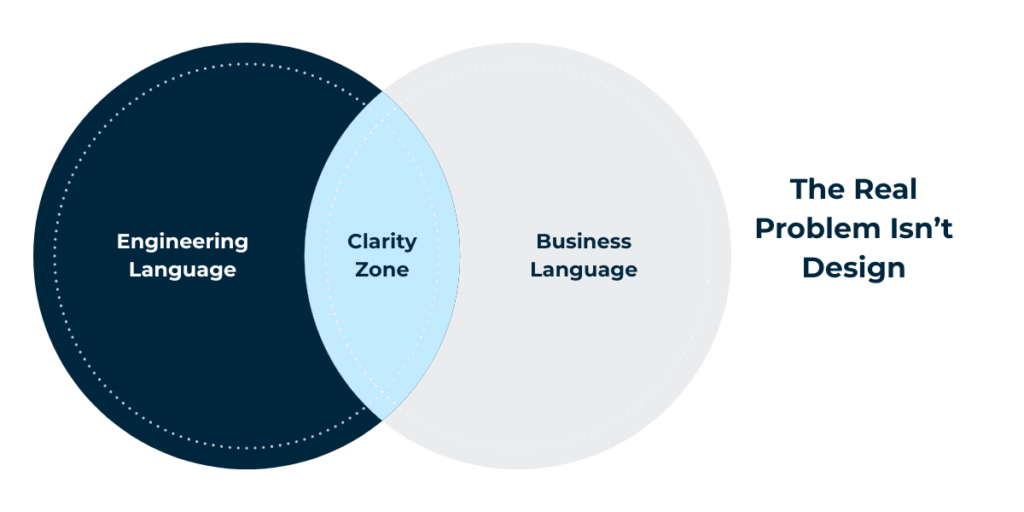
The Real Problem Isn’t Design —
It’s Language
Most industrial website design projects don’t fail because of poor visuals or weak SEO.
They fail because they’re written in the wrong language.
For broader insights on why many websites fail to communicate effectively in B2B and industrial sectors, explore:
Nielsen Norman Group – Research on Website Communication Clarity
HubSpot Blog – B2B Website Conversion & Messaging Best Practices
These sources consistently highlight communication gaps as a major barrier to effective website performance.
One half of the industry speaks engineering; the other half listens in business.
Somewhere between those two languages, clarity disappears — and so does credibility.
When a potential client visits an industrial website, they are not asking:
“What does this process do?”
They’re asking:
“Can this company solve my operational problem — safely, reliably, and at scale?”
If your website doesn’t answer that within the first scroll, you lose both attention and trust.
The Two Extremes
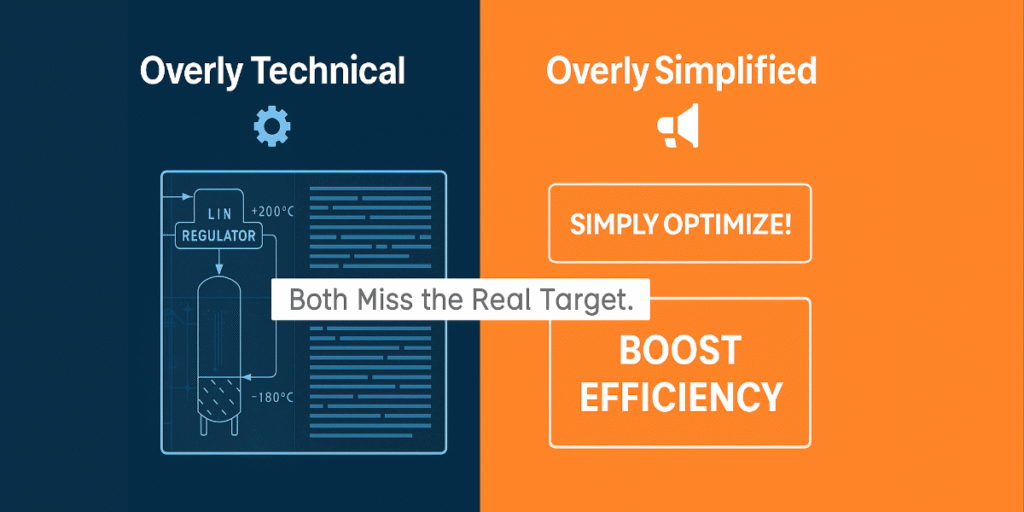
1️⃣ Overly Technical (Engineer-Centric)
Many engineering firms approach industrial website design like a tender document.
They overload every page with flow rates, capacities, and spec sheets.
While accuracy matters, decision-makers aren’t validating formulas — they’re validating fit and reliability.
They want to know why your company is competent, not how every valve functions.
2️⃣ Overly Simplified (Marketing-Centric)
On the opposite end, some industrial websites swing too far toward vague marketing language.
They trade facts for adjectives:
“Innovative solutions.”
“Cutting-edge technologies.”
“Customer-first philosophy.”
These phrases don’t build confidence — they create ambiguity.
They dilute the engineering integrity that makes your business credible in the first place.
The Missing Layer — Clarity Translation
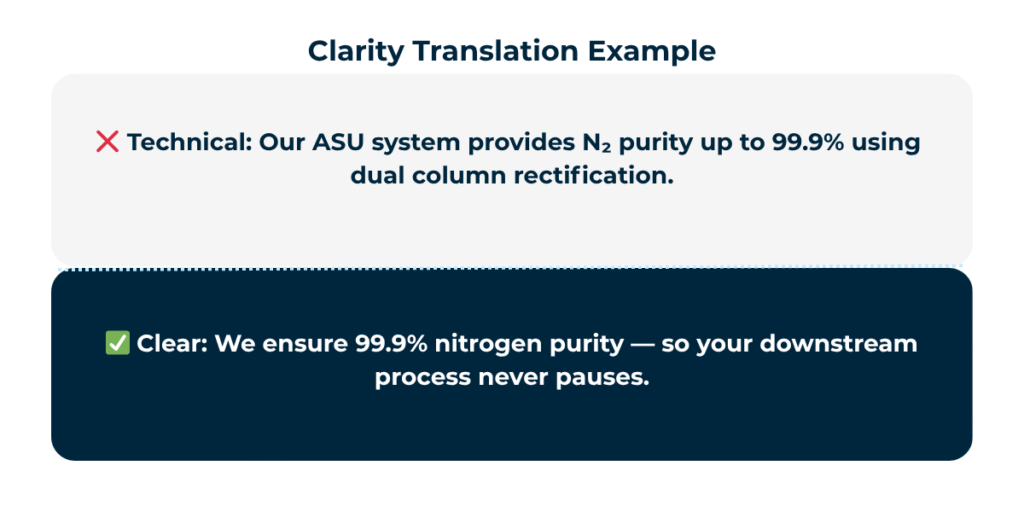
The most effective industrial website designs act as translators between two worlds:
- Engineering Logic → precise, technical, accurate
- Business Logic → results-driven, cost, safety, reliability
The clarity layer connects them.
It explains technical truth in business impact terms.
Example:
“Our nitrogen generation system maintains 99.9% purity — ensuring your downstream processes never pause due to gas inconsistencies.”
One line. Both technical and commercial. That’s clarity translation.
The Consulting Rule — Structure
Like a P&ID
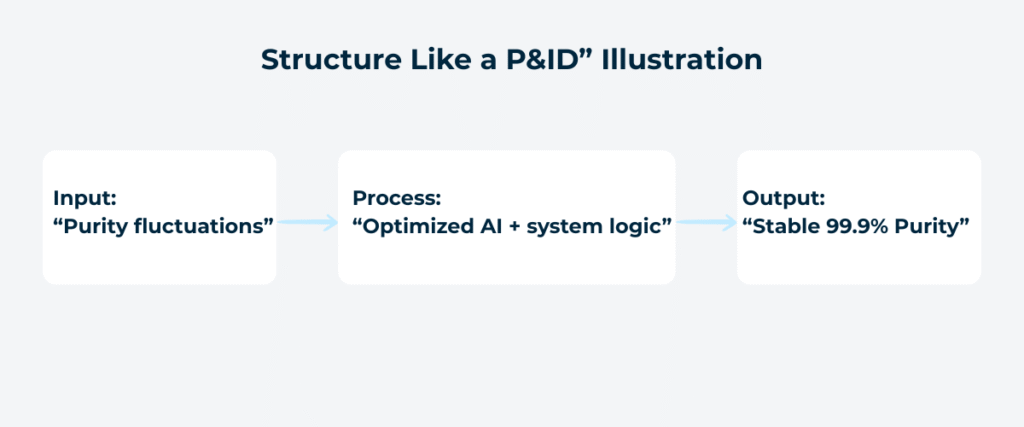
Engineers trust systems that are structured, traceable, and validated.
Your industrial website should follow the same principle.
Each page should have:
Clear Input: What challenge are we solving?
Defined Process: How do we solve it?
Measured Output: What’s the benefit or ROI?
That logical flow builds instant credibility — far more than any visual animation or fancy layout can.
Design Clarity Follows Language Clarity

In industrial website design, good visuals don’t fix weak language — they amplify strong messaging.
When content is written with precision, layouts naturally feel professional because the structure mirrors the way engineers think.
Industrial design and communication both follow the same core rule:
“Clarity equals confidence.”
Key Takeaway
An industrial website isn’t a brochure — it’s a 24/7 technical sales engineer that speaks on behalf of your organization.
It should bridge engineering expertise and business decision-making, not separate them.
When planning your next industrial website design, don’t start with wireframes — start with clarity mapping.