
📘 Engineering Knowledge Sharing — Why Engineers Must Publish Their Knowledge
Most engineers solve complex problems every day but rarely document how they did it.
This post explains why engineering knowledge sharing is no longer optional — it’s a sign of leadership and long-term credibility.

The Industrial World’s Silent Problem
Every day, engineers troubleshoot, optimize, and redesign critical systems — from compressors to cryogenic plants.
Yet, most of that intelligence remains locked inside notebooks, commissioning reports, or private folders.
The issue isn’t lack of expertise.
It’s the absence of engineering knowledge sharing.
When insights remain undocumented, industries end up solving the same problems repeatedly — wasting time, resources, and experience.
In the new era of digital operations, knowledge that isn’t shared simply doesn’t exist.
Invisible Expertise Is a Lost Asset

“When experience stays undocumented, it becomes invisible expertise — valuable, but lost.”
Engineers are trained to solve, not to explain.
Documentation often feels secondary to “real work.”
But visibility is no longer optional — it’s the foundation of credibility.
Engineering knowledge sharing isn’t self-promotion; it’s system optimization.
It turns individual experience into collective progress.
When engineers articulate what they learned, they make their thinking traceable — building confidence inside teams, across departments, and across industries.
That’s how technical expertise evolves into recognized leadership.
Publishing Turns Experience Into Authority
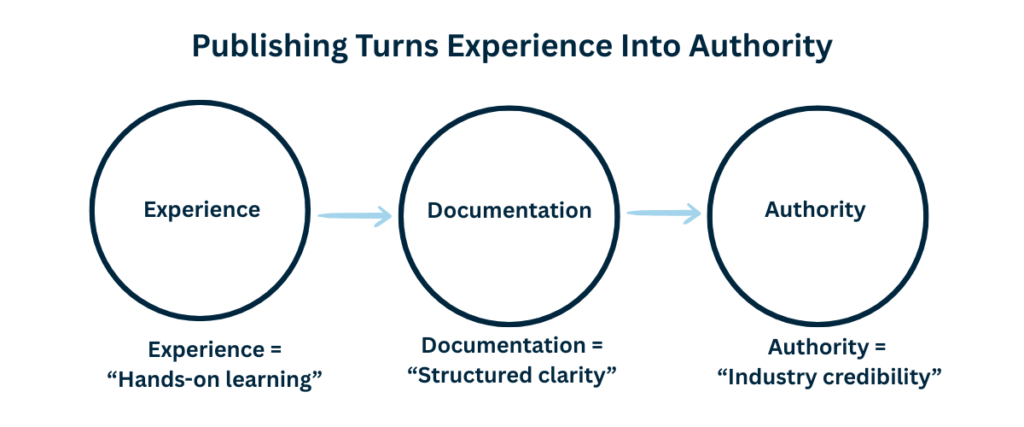
Every engineer holds data, lessons, and insights worth sharing.
When captured and shared, these transform personal experience into institutional wisdom.
🔹 Internal benefit: reduces dependency on individual experts.
🔹 Team benefit: helps new engineers onboard faster.
🔹 Industry benefit: builds trust through visible competence.
Publishing is the highest form of engineering knowledge sharing — moving from doing engineering to shaping engineering.
The engineers who document clarity today will define industry standards tomorrow.
Takeaway
Why Companies Should Encourage Knowledge Sharing

Internal Benefit
Improves team documentation and process consistency

Team
Benefit
Helps new engineers onboard faster

External Benefit
Builds client trust through visible expertise
Organizations often guard knowledge, fearing exposure of proprietary processes.
But clarity doesn’t weaken competitiveness — it strengthens reputation.
Transparent documentation shows technical maturity and operational confidence.
It reassures clients that the company understands its processes deeply enough to explain them publicly.
A culture of engineering knowledge sharing also drives:
- better internal documentation,
- more structured team thinking, and
- higher external credibility.
When a company publishes clearly, it signals both expertise and trustworthiness.
Many reputable organizations emphasize that structured documentation and transparent communication strengthen problem-solving and build long-term credibility.
For further reading on knowledge-sharing culture and organizational performance, see:
-
Harvard Business Review — Knowledge Sharing & Collaboration
McKinsey Insights— Organizational Capability & Documentation Practices
These resources consistently highlight how clarity, communication, and process discipline support stronger innovation and improved team performance across industries.
Start your next commissioning project with a proven structure.
Use the downloadable guide as a foundation for documentation, purity tracking, and final handover.
How to Start Engineering Knowledge Sharing

Write one short post per month about how a real problem was solved.
Share visuals or diagrams with one actionable takeaway.

Translate jargon into logic your clients or trainees can understand
You don’t need to be a writer — you need to be clear.
Start small and practical:
1️⃣ Write one short post per month about how a real problem was solved.
2️⃣ Share visuals or diagrams with one actionable takeaway.
3️⃣ Translate jargon into logic your clients or trainees can understand.
Every contribution compounds over time — building your professional credibility and your organization’s digital authority.
Visibility builds trust.
Clarity builds authority.
Publishing Is Leadership
In the modern industrial world, engineering knowledge sharing is not a side task — it’s a leadership act.
It shows responsibility, curiosity, and a willingness to advance the industry together.
The future won’t belong to quiet experts —
it will belong to the engineers who document, clarify, and share their knowledge.
Related Resources



Lorem ipsum dolor sit amet, consectetur adipiscing elit. Ut elit tellus, luctus nec ullamcorper mattis, pulvinar dapibus leo.