
🧠 AI in Predictive Maintenance — The Real ROI Is Precision, Not Prediction
By Graphic Medium Industrial Consulting | November 2025

Invisible ROI — What Most Plants Miss
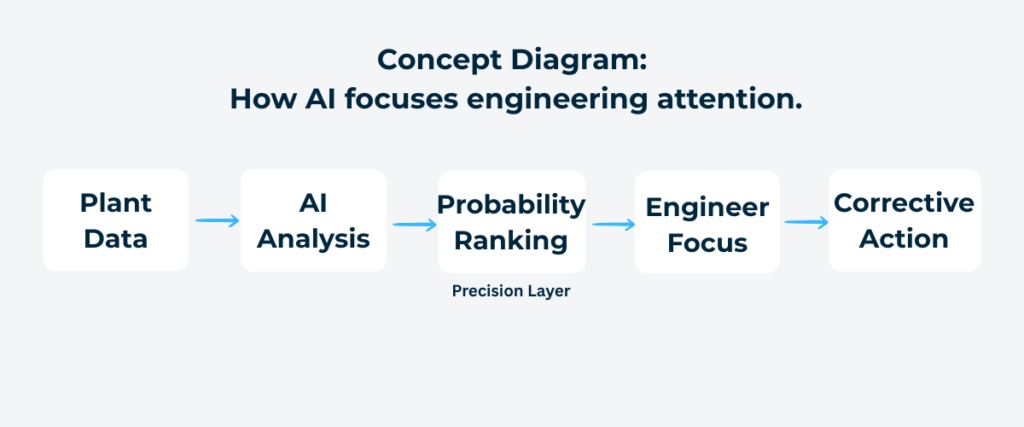
AI in Predictive Maintenance is one of the most overused phrases in industrial AI discussions.
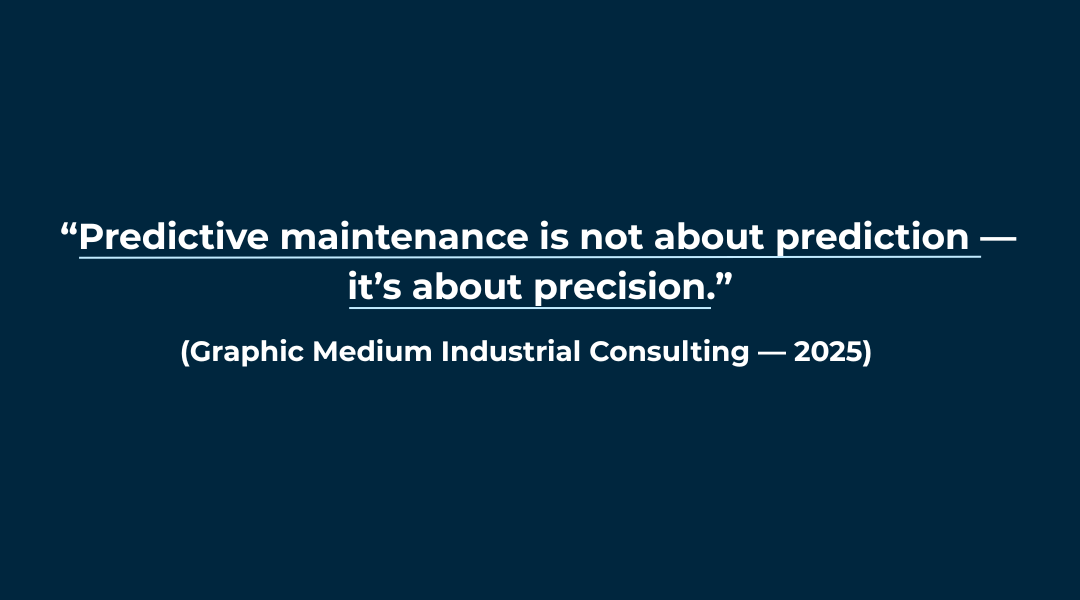
Yet, in real plants, the value of AI isn’t in “predicting failure.”
It’s in helping engineers focus precisely on where a problem is most likely to occur.
The cost of failure is not always in the breakdown itself.
It’s in the hours of search that follow — when teams check every subsystem, valve, and sensor in panic mode.
AI helps reduce that chaos by ranking probabilities, not guessing outcomes.
The result is not automation — it’s attention optimization.
Why Prediction Alone Doesn’t Help
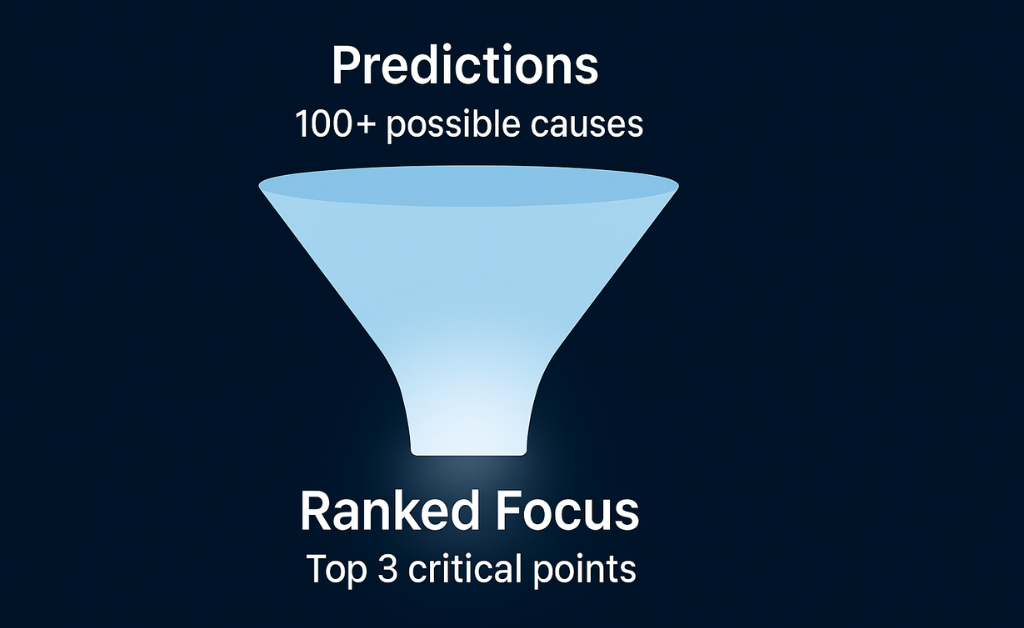
Visual: AI filters 100+ predictions into 3 actionable focus areas.
Most predictive systems try to forecast try to forecast when a failure will occur.
But engineers already know things will fail.
The real question is: which variable, in which zone, deserves attention first?
That’s where AI in Predictive Maintenance shifts the ROI discussion —
from prediction to precision.
When models are trained on actual process data — not just thresholds —
they begin to identify patterns of probability.
That’s when engineering judgment becomes faster, not weaker.
Cryogenic Example — Purity Slip
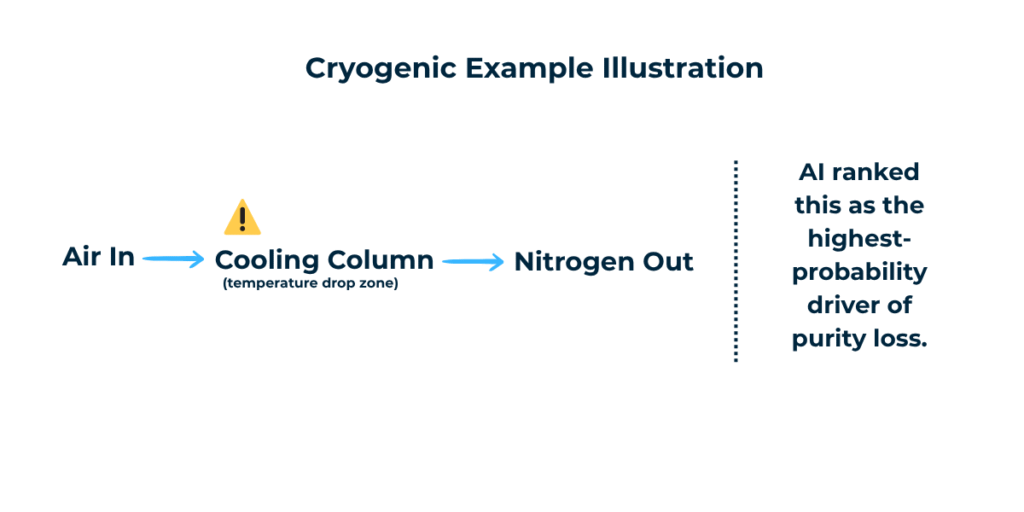
AI highlights the most probable purity loss zone — turning hours of search into minutes of insight.
In one nitrogen plant, purity dropped from 99.8% to 99.5% within hours.
Operators checked dryer performance, valve positioning, and tower balance — everything looked normal.
But when AI in Predictive Maintenance models compared live trends to historical micro-patterns,
one small cooling inefficiency at the column base was ranked as the highest-probability driver.
Instead of six hours of random troubleshooting,
the issue was found in under 40 minutes.
The AI didn’t fix the plant — the engineers did.
But it made their time 5x more valuable
Precision = ROI
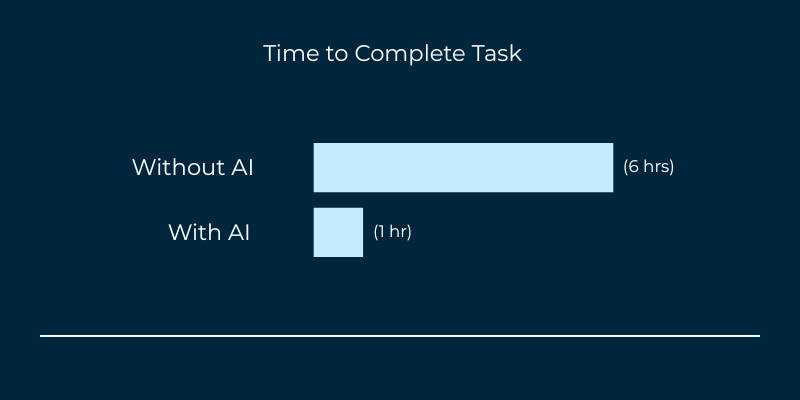
Typical reduction in troubleshooting time observed in AI-assisted maintenance.
In industrial operations, every hour of targeted attention saves hundreds of hours of guesswork.
That’s where predictive maintenance actually delivers ROI.
AI’s purpose is not to replace engineering expertise —
it’s to remove the noise that hides it.
When used correctly, predictive tools don’t predict failures —
they prioritize insight.
Key Takeaway
AI in Predictive Maintenance isn’t about building smarter machines —
it’s about building sharper decision loops.
The faster an engineer can identify the root cause,
the faster an organization moves from maintenance to performance.
Related Resources

For broader industry perspectives on AI, predictive maintenance, and data-driven operations, you may explore:
• IBM — Predictive Maintenance & Industrial AI
Insights on how AI identifies patterns, reduces unplanned downtime, and improves maintenance planning.
(General overview, no claims implied.)
• Siemens — Industrial Analytics & Condition Monitoring
Covers how data-driven diagnostics support faster troubleshooting and operational clarity.
• Deloitte Insights — AI in Industrial Operations
Discusses how AI shifts industrial decision-making from reactive to proactive frameworks.
• NVIDIA — Applied AI for Industrial Sensors & Predictive Models
Explains how machine learning helps identify anomalies and trends in real-time plant data.
• McKinsey Digital — AI & Maintenance Optimization
Provides thought-leadership articles on how AI improves maintenance workflows and operational decision-making.